Which Movement or Style of Art Is Amrita Shergil
| Amrita Sher-Gil | |
|---|---|
 | |
| Born | (1913-01-30)xxx Jan 1913 Budapest, Kingdom of Hungary |
| Died | v December 1941(1941-12-05) (aged 28) Lahore, Punjab, British Bharat |
| Nationality | Hungarian British Indian |
| Instruction |
|
| Known for | Painting |
| Spouse(southward) | Viktor Egan |
Amrita Sher-Gil (30 Jan 1913 – 5 December 1941) was a Hungarian-Indian painter. She has been called "ane of the greatest advanced women artists of the early on 20th century" and a "pioneer" in mod Indian art. Drawn to painting from an early age, Sher-Gil started getting formal lessons in the art, at the historic period of 8. She first gained recognition at the age of nineteen, for her oil painting titled Young Girls (1932). Sher-Gil depicted everyday life of the people in her paintings.
Sher-Gil traveled throughout her life to diverse countries including Turkey, France, and India, deriving heavily from precolonial Indian art styles and its current culture. Sher-Gil is considered an important painter of 20th-century India, whose legacy stands on a level with that of the pioneers from the Bengal Renaissance. She was also an avid reader and a pianist. Sher-Gil's paintings are among the nigh expensive by Indian women painters today, although few acknowledged her work when she was alive.
Early life and didactics [edit]

Amrita with her sister Indira, 1922
Amrita Sher-Gil was born on 30 January 1913[1] in Budapest, Hungary,[2] to Umrao Singh Sher-Gil Majithia, an Indian Punjabi Sikh aristocrat and a scholar in Sanskrit and Persian, and Marie Antoinette Gottesmann, a Hungarian-Jewish opera vocalizer who came from an affluent bourgeois family.[3] [4] Her parents first met in 1912, while Marie Antoinette was visiting Lahore.[3] Her mother came to India as a companion of Princess Bamba Sutherland, the granddaughter of Maharaja Ranjit Singh.[5] [vi] Sher-Gil was the elder of two daughters; her younger sis was Indira Sundaram (née Sher-Gil; built-in in March 1914), female parent of the gimmicky artist Vivan Sundaram. She spent well-nigh of her early babyhood in Budapest.[three] She was the niece of Indologist Ervin Baktay. Baktay noticed Sher-Gil's creative talents during his visit to Shimla in 1926 and was an advocate of Sher-Gil pursuing fine art.[4] He guided her past critiquing her work and gave her an academic foundation to grow on. When she was a young girl she would paint the servants in her firm, and get them to model for her.[7] The memories of these models would eventually atomic number 82 to her return to India.[8]
Her family faced financial problems in Hungary. In 1921, her family unit moved to Summer Hill, Shimla, India, and Sher-Gil before long began learning pianoforte and violin.[7] By age 9 she, forth with her younger sister Indira, was giving concerts and acting in plays at Shimla's Gaiety Theatre at Mall Road, Shimla.[9] Though she had already been painting since the age of 5, she started learning painting formally at historic period eight.[ix] Sher-Gil started getting formal lessons in art from Major Whitmarsh, who was later replaced by Beven Pateman. In Shimla, Sher-Gil lived a relatively privileged lifestyle.[3] As a child, she was expelled from her convent schoolhouse for declaring herself an atheist.[3]
In 1923, Marie came to know an Italian sculptor, who was living in Shimla at the time. In 1924, when he returned to Italy, she too moved at that place, forth with Amrita, and got her enrolled at Santa Annunziata, an art school in Florence. Though Amrita did non stay at this school for long and returned to India in 1924, it was here that she was exposed to works of Italian masters.[10]
At xvi, Sher-Gil sailed to Europe with her female parent to train as a painter in Paris, start at the Académie de la Grande Chaumière under Pierre Vaillent and Lucien Simon (where she met Boris Taslitzky) and subsequently at the École des Beaux-Arts (1930–34).[11] [12] She drew inspiration from European painters such as Paul Cézanne and Paul Gauguin,[13] while working under the influence of her instructor Lucien Simon and through the company of artist friends and lovers like Tazlitsky. While in Paris, she is said to have painted with a conviction and maturity rarely seen in a xvi-year old.[four]
In 1931, Sher-Gil was briefly engaged to Yusuf Ali Khan, but rumours spread that she was likewise having an affair with her starting time cousin and later husband Viktor Egan.[14] Her letters reveal same-sex affairs.[15]
Career [edit]
1932–1936: Early career, European and Western styles [edit]

Young Girls, 1932, oil on canvas, 133×164 cm, National Gallery of Modern Art, Delhi
Sher-Gil's early paintings brandish a significant influence of the Western modes of painting, more than specifically, the mail service-impressionism fashion. She practiced a lot in the Bohemian circles of Paris in the early 1930s. Her 1932 oil painting, Young Girls, came as a breakthrough for her; the work won her accolades, including a gold medal and election as an Associate of the Grand Salon in Paris in 1933. She was the youngest e'er member,[16] [17] [18] and the merely Asian to have received this recognition.[10] Her work during this time include a number of self-portraits, besides as life in Paris, nude studies, all the same life studies, and portraits of friends and fellow students.[19] The National Gallery of Modern Fine art in New Delhi describes her self-portraits she made while in Paris as "[capturing] the artist in her many moods – somber, pensive, and joyous – while revealing a egotistic streak in her personality."[19]

Sleep, 1932, oil on sail 112.v × 79 cm, National Gallery of Modernistic Fine art, Delhi
When she was in Paris, one of her professors often said that judging by the richness of her colouring Sher-Gil was not in her element in the west, and that her artistic personality would discover its true atmosphere in the east.[xx] In 1933, Sher-Gil "began to exist haunted by an intense longing to render to Republic of india feeling in some foreign manner that in that location lay her destiny as a painter." Sher-Gill returned to India at the end of 1934.[21] [20] In May 1935, Sher-Gil met the English language journalist Malcolm Muggeridge, and so working as banana editor and leader writer for The Calcutta Statesman.[22] Both Muggeridge and Sher-Gil stayed at the family dwelling house at Summer Hill, Shimla and a brusque intense matter took place during which she painted a coincidental portrait of her new lover, the painting now with the National Gallery of Modern Art in New Delhi. By September 1935 Amrita saw Muggeridge off as he traveled back to England for new employment.[23] She left herself for travel in 1936 at the bidding of an fine art collector and critic, Karl Khandalavala, who encouraged her to pursue her passion for discovering her Indian roots.[13] In India, she began a quest for the rediscovery of the traditions of Indian art which was to continue till her expiry. She was greatly impressed and influenced past the Mughal and Pahari schools of painting and the cave paintings at Ajanta.

South Indian Villagers Going to Market, 1937.
1937–1941: Later career, influence of Indian art [edit]
Afterwards in 1937, she toured South India[13] and produced her Southward Indian trilogy of paintings Bride'southward Toilet, Brahmacharis, and S Indian Villagers Going to Market post-obit her visit to the Ajanta Caves, when she made a conscious try to render to classical Indian art. These paintings reveal her passionate sense of color and an equally passionate empathy for her Indian subjects, who are oftentimes depicted in their poverty and despair.[24] Past at present the transformation in her work was complete and she had found her 'creative mission' which was, according to her, to express the life of Indian people through her sail.[1] While in Saraya Sher-Gil wrote to a friend thus: "I tin can just paint in Republic of india. Europe belongs to Picasso, Matisse, Braque.... Republic of india belongs only to me".[25] Her stay in India marks the beginning of a new stage in her artistic evolution, 1 that was distinct from the European phase of the interwar years when her work showed an engagement with the works of Hungarian painters, especially the Nagybanya school of painting.[26]
Sher-Gil married her Hungarian first cousin, Dr. Viktor Egan when she was 25.[3] Egan had helped Sher-Gil obtain abortions on at least 2 occasions prior to their marriage.[3] She moved with him to Bharat to stay at her paternal family's habitation in Saraya, Sardar nagar, Chauri Chaura in Gorakhpur, Uttar Pradesh. Thus began her second stage of painting which equals in its affect on Indian fine art with the likes of Rabindranath Tagore and Jamini Roy of the Bengal school of fine art. The 'Calcutta Group' of artists, which transformed the Indian art scene, was to start only in 1943, and the 'Progressive Creative person'due south Group', with Francis Newton Souza, Ara, Bakre, Gade, Thou. F. Husain and Due south. H. Raza among its founders, lay further alee in 1948.[27] [28] [29] Sher-Gil's fine art was strongly influenced by the paintings of the ii Tagores, Rabindranath and Abanindranath who were the pioneers of the Bengal School of painting. Her portraits of women resemble works by Rabindranath while the employ of 'chiaroscuro' and bright colors reflect the influence of Abanindranath.[30]
Information technology was during her stay at Saraya that Sher-Gil painted the Village Scene, In the Ladies' Enclosure, and Siesta, all of which portray the leisurely rhythms of life in rural India. Siesta and In the Ladies' Enclosure reflect her experimentation with the miniature school of painting while Village Scene reflects influences of the Pahari school of painting.[31] Although acclaimed by fine art critics Karl Khandalavala in Bombay and Charles Fabri in Lahore as the greatest painter of the century, Sher-Gil's paintings found few buyers. She travelled across Republic of india with her paintings but the Nawab Salar Jung of Hyderabad returned them and the Maharaja of Mysore chose Ravi Varma'southward paintings over hers.[32]
Although from a family unit that was closely tied to the British Raj, Sher-Gil herself was a Congress sympathiser. She was attracted to the poor, distressed and the deprived and her paintings of Indian villagers and women are a meditative reflection of their condition. She was also attracted by Gandhi'southward philosophy and lifestyle. Nehru was overjoyed by her beauty and talent and when he went to Gorakhpur in October 1940, he visited her at Saraya. Her paintings were at i stage fifty-fifty considered for use in the Congress propaganda for village reconstruction.[25] However, despite existence friends with Nehru, Sher-Gil never drew his portrait, supposedly considering the artist thought he was "as well good looking."[33] Nehru attended her exhibition held in New Delhi in February 1937.[33] Sher-Gil exchanged letters with Nehru for a time, merely those messages were burned by her parents when she was away getting married in Budapest.[33]
In September 1941, Egan and Sher-Gil moved to Lahore, and then in undivided India and a major cultural and artistic eye. She lived and painted at 23 Ganga Ram Mansions, The Mall, Lahore where her studio was on the tiptop floor of the townhouse she inhabited. Sher-Gil was known for her many diplomacy with both men and women,[21] and she also painted many of the latter. Her piece of work 2 Women is thought to be a painting of herself and her lover Marie Louise.[34] Some of her after works include Tahitian (1937), Ruddy Brick House (1938), Hill Scene (1938), and The Bride (1940) amongst others. Her concluding work was left unfinished but prior to her death in December 1941.
In 1941, at historic period 28, just days earlier the opening of her first major solo prove in Lahore, Sher-Gil became seriously sick and slipped into a blackout.[21] [35] [36] She later died around midnight on five December 1941,[37] leaving behind a large volume of piece of work. The reason for her death has never been ascertained. A failed abortion and subsequent peritonitis have been suggested as possible causes for her expiry.[38] Her mother accused her md married man Egan of having murdered her. The twenty-four hours after her expiry, Britain declared war on Hungary and Egan was interned as an enemy alien. Sher-Gil was cremated on 7 December 1941 in Lahore.[32]
Legacy [edit]

Road named in Delhi after Sher-Gil
Sher-Gil'due south art has influenced generations of Indian artists from Sayed Haider Raza to Arpita Singh and her depiction of the plight of women has made her art a buoy for women at large both in India and abroad.[39] The Government of Republic of india has declared her works as National Art Treasures,[27] [7] and near of them are housed in the National Gallery of Mod Art in New Delhi.[xl] [19] Some of her paintings likewise hang at the Lahore Museum.[41] A stamp stamp depicting her painting 'Colina Women' was released in 1978 by India Mail, and the Amrita Shergil Marg is a route in Lutyens' Delhi named after her. Sher-Gil was able to prove to western societies that Indians were able to brand art. Her piece of work is deemed to be so of import to Indian culture that when it is sold in Republic of india, the Indian authorities has stipulated that the fine art must stay in the land – fewer than x of her works have been sold globally.[fourteen] In 2006, her painting Village Scene sold for ₹6.9 crores at an auction in New Delhi which was at the time the highest corporeality ever paid for a painting in Bharat.[31]
The Indian cultural center in Budapest is named the Amrita Sher-Gil Cultural Center.[35] Contemporary artists in Bharat have recreated and reinterpreted her works.[42]
Amrita Sher-Gil (1969) is a documentary film near the creative person, directed by Bhagwan Das Garga and produced past the Authorities of Bharat'due south Films Division. It won the National Film Laurels for Best Non-Feature Film.[43]
As well remaining an inspiration to many a contemporary Indian artists, in 1993, she besides became the inspiration behind the Urdu play Tumhari Amrita.[44] [7]
UNESCO announced 2013, the 100th ceremony of Sher-Gil's birth, to be the international yr of Amrita Sher-Gil.[45]
Sher-Gil's piece of work is a fundamental theme in the gimmicky Indian novel Faking It by Amrita Chowdhury.[46]
Aurora Zogoiby, a character in Salman Rushdie'due south 1995 novel The Moor'due south Final Sigh, was inspired by Sher-Gil.[47]
Sher-Gil was sometimes known as India's Frida Kahlo considering of the "revolutionary" way she composite Western and traditional fine art forms.[3] [27]
On thirty January 2016, Google celebrated her 103rd altogether with a Google Putter.[48]
In 2018, The New York Times published a belated obituary for her.[49]
In 2018, at a Sotheby'due south auction in Mumbai, Sher-Gil's painting "The Little Girl in Blue" was auctioned for a record-breaking eighteen.69 crores. This painting is a portrait of Amrita's cousin Babit, a resident of Shimla and was painted in 1934, when the subject was 8 years erstwhile.[fifty]
Gallery [edit]
-

Cocky-portrait, 1930
-
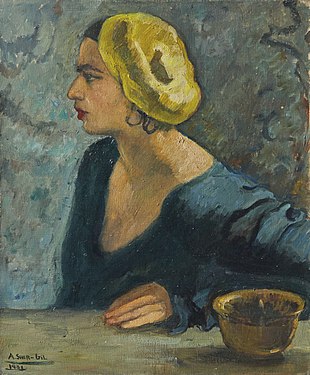
Self-portrait (untitled), 1931
-

Klára Szepessy, 1932
-
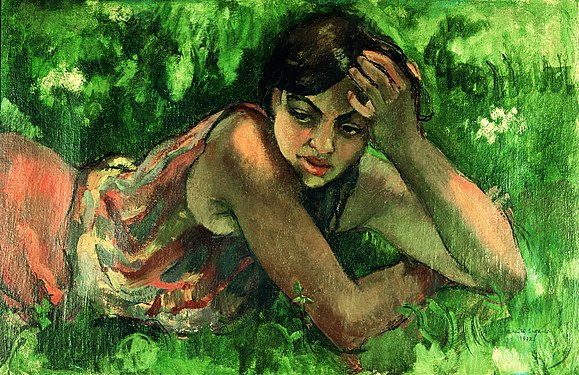
Hungarian Gypsy Daughter, 1932[a]
-

Group of 3 Girls, 1935
-

Bride'southward Toilet, 1937
-

Village Scene, 1938
Notes [edit]
- ^ Originally titled Gypsy Girl
References [edit]
- ^ a b Groovy Minds Archived 27 Nov 2020 at the Wayback Machine, The Tribune, 12 March 2000.
- ^ "Budapest Diary". Outlook. 20 September 2010. Archived from the original on 29 May 2012. Retrieved five February 2013.
- ^ a b c d e f g h "The Indian Frida Kahlo". Telegraph.co.united kingdom of great britain and northern ireland. Archived from the original on 26 March 2019. Retrieved xiv May 2017.
- ^ a b c "Revolution personified | Christie's'". Archived from the original on 7 June 2021. Retrieved 14 May 2017.
- ^ Kang, Kanwarjit Singh (xx September 2009). "The Princess who died unknown". The Dominicus Tribune. Archived from the original on 5 June 2011. Retrieved 13 March 2010.
- ^ Singh, Khushwant (27 March 2006). "Hamari Amrita". Outlook. Archived from the original on 6 Feb 2013. Retrieved 5 Feb 2013.
- ^ a b c d "Google's Doodle Honours Amrita Sher-Gil. Hither Are 5 Things You lot Should Know near Her". The Better India. 30 Jan 2016. Archived from the original on 9 June 2021. Retrieved 14 May 2017.
- ^ On Amrita Sher-Gil: Claiming a Radiant Legacy By Nilima Sheikh
- ^ a b Amrita Shergill at sikh-heritage Archived 23 Feb 2020 at the Wayback Machine. Sikh-heritage.co.uk (xxx January 1913).
- ^ a b Amrita Shergill Biography at Archived 26 Feb 2021 at the Wayback Machine. Iloveindia.com (6 Dec 1941).
- ^ Archives 'Amrita Shergil' projection Archived seven January 2009 at the Wayback Machine www.hausderkunst.de.
- ^ Amrita Sher-Gil contour at Archived 15 October 2012 at the Wayback Auto. Indianartcircle.com.
- ^ a b c "Amrita Sher-Gil Exhibition at tate.org". Archived from the original on 21 Jan 2021. Retrieved 11 December 2014.
- ^ a b Singh, Rani. "Undiscovered Amrita Sher-Gil Self-Portrait And Rare Indian Emerald Bangles Up For Auction". Forbes. Archived from the original on 17 January 2021. Retrieved fourteen May 2017.
- ^ (Some names accept been changed to protect their identities). "A life not and then gay". Telegraphindia.com. Archived from the original on 5 May 2018. Retrieved 23 June 2018.
- ^ Anand, Mulk Raj (1989). Amrita Sher-Gill. Jaipur: National Gallery of Modern Fine art.
- ^ Works in Focus Archived 21 January 2021 at the Wayback Machine, Tate Modern, 2007.
- ^ Amrita Shergil at tate Archived 29 Feb 2020 at the Wayback Machine. En.ce.cn.
- ^ a b c "National Gallery of Modernistic Fine art, New Delhi". world wide web.ngmaindia.gov.in. Archived from the original on 11 July 2021. Retrieved 14 May 2017.
- ^ a b Dalmia, Yashodhara (2014). Amrita Sher-Gil: Art & Life: A Reader. New Delhi: Oxford University Printing. p. 5. ISBN978-0-xix-809886-seven.
- ^ a b c Laid bare – the gratis spirit of Indian art The Daily Telegraph, 24 February 2007.
- ^ Bright-Holmes, John (1981). Like Information technology Was: The Diaries of Malcolm Muggeridge . entry dated 18 January 1951: Collins. p. 426. ISBN978-0-688-00784-iii . Retrieved 29 August 2011.
{{cite book}}: CS1 maint: location (link) - ^ Wolfe, Gregory (2003). Malcolm Muggeridge: A Biography. Intercollegiate Studies Found. pp. 136–137. ISBN1932236066.
- ^ Amrita Shergill at Archived 29 January 2020 at the Wayback Motorcar. Indiaprofile.com (vi December 1941).
- ^ a b "Amrita's hamlet". Frontline. 30 (4). February–March 2013. Retrieved 26 February 2013.
- ^ Daily Times, 15 Dec 2004 Archived xxx March 2012 at the Wayback Machine. Dailytimes.com.pk (15 Dec 2004).
- ^ a b c Amrita Sher-Gill at Archived iv April 2019 at the Wayback Machine. Mapsofindia.com.
- ^ Contemporary Fine art Movements in India Archived 26 Feb 2020 at the Wayback Car. Contemporaryart-india.com.
- ^ Indian artists Archived 19 June 2006 at the Wayback Machine. Art.in.
- ^ "Fine art into life". HT Mint. 31 January 2013. Archived from the original on 1 December 2020. Retrieved half dozen February 2013.
- ^ a b "White Shadows". Outlook. xx March 2006. Archived from the original on 26 January 2013. Retrieved five Feb 2013.
- ^ a b "Hamari Amrita". Outlook. 27 March 2006. Archived from the original on half dozen Feb 2013. Retrieved five February 2013.
- ^ a b c "Why Amrita Sher-Gil refused to draw Nehru's portrait : Art and Civilization". indiatoday.intoday.in. Archived from the original on 14 September 2017. Retrieved fourteen May 2017.
- ^ "Passion And Precedent". Outlook. 21 December 1998. Archived from the original on two February 2014. Retrieved five February 2013.
- ^ a b "Great success in a brusque life | The Budapest Times". budapesttimes.hu. Archived from the original on 24 January 2016. Retrieved xiv May 2017.
- ^ "Amrita Sher-Gil: This Is Me, Incarnations: Bharat in l Lives – BBC Radio 4". BBC. Archived from the original on 31 December 2019. Retrieved 14 May 2017.
- ^ Singh, N Iqbal (July 1975). "Amrita Sher-Gil". India International Middle Quarterly. 2 (iii): 216. JSTOR 23001838.
- ^ Truth, Honey and a Little Malice, An Autobiography by Khushwant Singh Penguin, 2003. ISBN 0-14-302957-half dozen.
- ^ "Sad In Brilliant Clothes". Outlook. 28 January 2013. Archived from the original on 2 February 2014. Retrieved 5 Feb 2013.
- ^ Amrita Sher-Gil at Archived 26 March 2019 at the Wayback Machine. Culturalindia.internet (30 January 1913).
- ^ Dutt, Nirupama. "When Amrita Sher-Gil vowed to seduce Khushwant Singh to take revenge on his wife". Curl.in. Archived from the original on 5 February 2021. Retrieved fourteen May 2017.
- ^ "Ii artists are recreating painter Amrita Sher-Gil's self portraits". Hindustan Times. 23 March 2017. Archived from the original on 26 March 2019. Retrieved xiv May 2017.
- ^ Jag Mohan (1990). Documentary films and Indian Awakening. Publications Division. p. 128. ISBN978-81-230-2363-ii. Archived from the original on xviii April 2021. Retrieved 21 February 2021.
- ^ Digital encounters The Hindu, thirteen August 2006]
- ^ "Amrita Sher-Gil in Paris | Magyar Művészeti Akadémia". world wide web.mma.hu. Archived from the original on 26 March 2019. Retrieved 14 May 2017.
- ^ Chowdhury, Amrita Five. (7 Baronial 2012). Faking Information technology – Amrita V Chowdhury. ISBN9789350094051. Archived from the original on 5 December 2021. Retrieved v February 2013.
- ^ "Amrita Sher-Gil: A Self-Portrait in Letters and Writings", ed. Vivan Sundaram, Tulika Books, 2010.
- ^ "Amrita Sher-Gil's 103rd Birthday". Google. 30 Jan 2016. Archived from the original on 19 February 2021. Retrieved 1 June 2020.
- ^ "Overlooked No More: Amrita Sher-Gil, a Pioneer of Indian Art". The New York Times. 21 June 2018. Archived from the original on 27 March 2019. Retrieved 23 June 2018.
- ^ "Sotheby's Mumbai auction: Amrita Sher-Gil's 'The Little Girl in Blue' fetches record bid of ₹18.69 crore". 30 November 2018. Archived from the original on 26 March 2019. Retrieved 1 February 2019.
Farther reading [edit]
- Ananth, Deepak (2007). Amrita Sher-Gil: An Indian Artist Family unit of the Twentieth Century. Munich: Schirmer/Mosel. ISBN978-iii-8296-0270-9. OCLC 166903259.
- Dalmia, Yashodhara (2013) [2006]. Amrita Sher-Gil: A Life . New York: Penguin. ISBN978-81-8475-921-1. OCLC 973928579 – via OverDrive.
- Doctor, Geeta (2002). Amrita Sher Gil: A Painted Life. New Delhi: Rupa & Co. ISBN978-81-7167-688-0. OCLC 50728719.
- Khandalavala, Karl J. (1945). Amrita Sher-Gil. Bombay: New Book Co. OCLC 2605226.
- Gupta, Indra (2004) [2003]. India's 50 Most Illustrious Women (2nd ed.). New Delhi: Icon Publications. ISBN978-81-88086-nineteen-i. OCLC 858639936.
- Kapur, Geeta (2020) [2000]. When was Modernism: Essays on Contemporary Cultural Practise in Republic of india. New Delhi, India: Tulika Books. ISBN978-81-89487-24-9. OCLC 1129791065. [ page needed ]
- Nandan, Kanhaiyalal; Shergil, Amrita (1987). Amrita Shergil (in Hindi). Delhi: Parag. OCLC 59068198.
- Rahman, Maseeh (vi October 2014). "In the shadow of decease". The Arts. India Today. 39 (forty): 68–69.
- Salim, Ahmad (1987). Amrita Sher-Gil: a personal view. Karachi: Istaʹarah Publications. OCLC 21297600.
- Śarmā, Vishwamitra (2008). "Amirita Shergil, Maestro of Modern Art (1913–1941)". Famous Indians of the 20th Century. New Delhi: Pustak Mahal. pp. 153–154. ISBN978-81-920796-8-4. OCLC 800734508 – via Internet Archive.
- Sen, Geeti (2002). "Chapter II: Woman Resting on a Charpoy". Feminine Fables: Imaging the Indian Woman in Painting, Photography and Movie theater . Ahmedabad & Middletown, NJ: Mapin Pub. Grantha Corp. pp. 10, 14–16, 61–100, 136. ISBN978-81-85822-88-4. OCLC 988874350 – via Internet Annal.
- Sher-Gil, Amrita (1943). The art of Amrita Sher-Gil (ten coloured plates). Roerich Eye of Art and Culture. Allahabad: Allahabad Cake Works. OCLC 699310.
- Sher-Gil, Amrita; Appasamy, Jaya; Dhingra, Baldoon (1965). Sher-Gil. New Delhi: Lalit Kala Akademi. OCLC 837971308.
- Sher-Gil, Amrita (2010). Sundaram, Vivan (ed.). Amrita Sher-Gil: A Self-Portrait in Letters and Writings. New Delhi: Tulika Books. ISBN978-81-89487-59-1. OCLC 551378380.
- Singh, Narayan Iqbal (1984). Amrita Sher-Gil: A Biography. New Delhi: Vikas. ISBN978-0-7069-2474-nine. OCLC 12810037.
- Sundaram, Vivan (1972). Amrita Sher-Gil; essays . Bombay: Marg Publications; sole distributors: India Book Centre, New Delhi. OCLC 643542124.
- Sundaram, Vivan; Sher-Gil, Umrao Singh (2001). Re-Take of Amrita : Digital Photomontages Based on Photographs by Umrao Singh Sher-Gil (1870-1954) and Photographs from the Sher-Gil Family unit Archive. New Delhi: Tulika. ISBN978-81-85229-49-2. OCLC 50004509.
- Wojtilla, Gyula; Sher-Gil, Amrita (1981). Amrita Sher-Gil and Hungary . New Delhi: Allied Publishers. OCLC 793843789.
External links [edit]
- JRF, Dileep (22 Nov 2019). "अमृता शेरगिल 1913-1941" [Amrita Shergill 1913-1941]. History of Fine Art (in Hindi). Retrieved xiii April 2022.
- NGMA. "Virtual Galleries - Amrita Sher-Gil". National Gallery of Modern Art. New Delhi. Retrieved 13 Apr 2022.
- Sharma, Mahima (15 March 2022). "Amrita Sher Gil A Bisexual Artist Who Fifty-fifty Spellbound Nehru". Simplykalaa Homepage.
Source: https://en.wikipedia.org/wiki/Amrita_Sher-Gil#:~:text=Amrita%20Sher%2DGil%20(30%20January,pioneer%22%20in%20modern%20Indian%20art.
0 Response to "Which Movement or Style of Art Is Amrita Shergil"
Post a Comment